
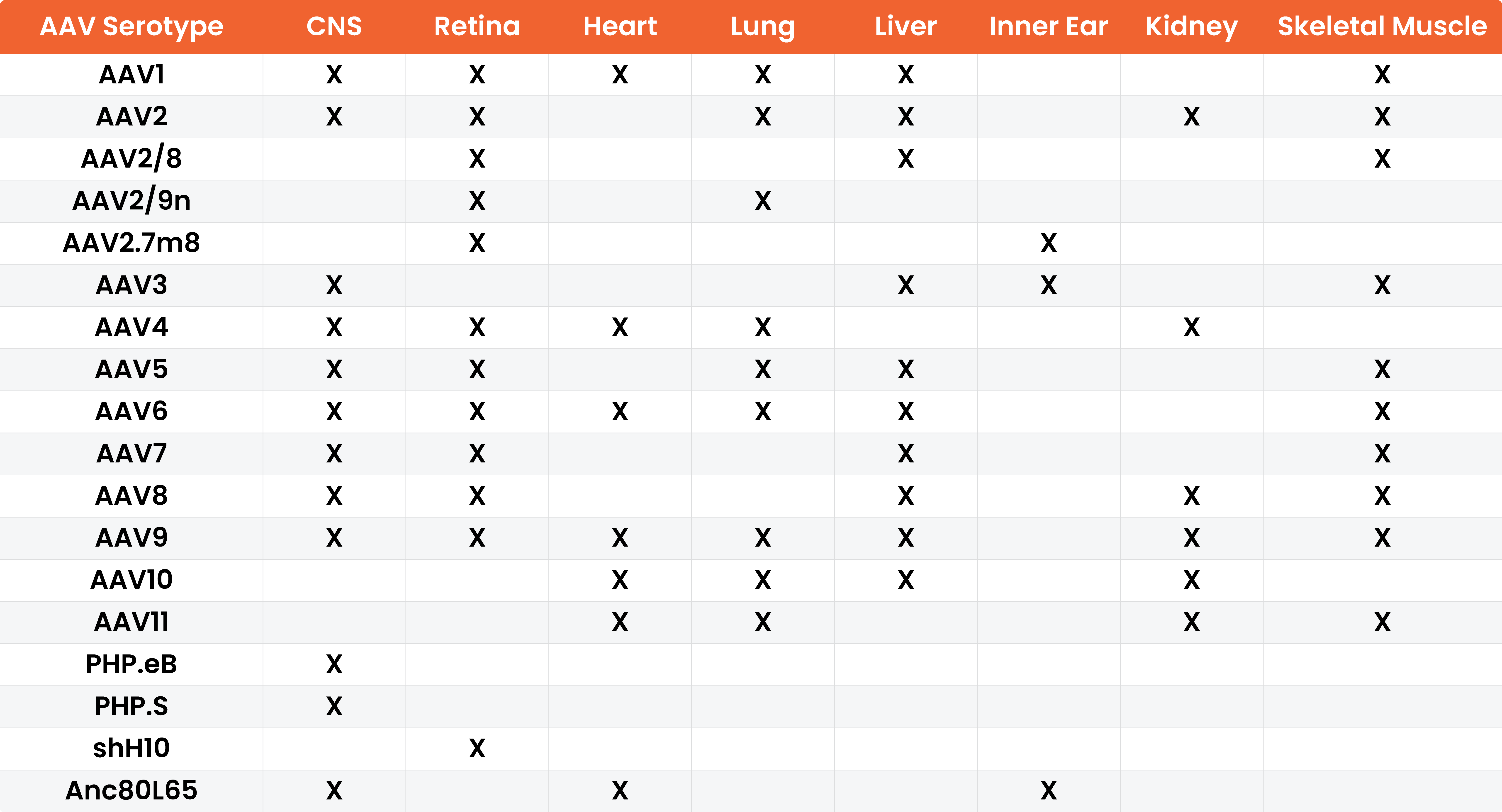
As a leading expert in AAV technology, abm provides a Custom AAV Service to assist with the design, cloning, and viral packaging of your unique AAV construct. We offer a wide selection of AAV serotypes, including 1-11, AAV2/8, AAV2/9n, AAV2.7m8, PHP.eB, PHP.S, shH10 and Anc80L65. Our purification options include crude preparations (ideal for in vitro experiments) and purified versions (optimized for in vivo applications). Inquire with us below to get started on your Custom AAV project.
Advantages of the AAV System:
Used as a promising candidate for gene therapy
Does not elicit significant immune responses in vivo
Broad tropism - tissue specificity with different AAV serotypes
No integration into the host genome
Ability to transduce both proliferating and quiescent cells
Custom AAV plasmid cloning without compatible insert
1 Service
C235
*For these services, the customer must provide a gene insert under 3kb. Please contact technical@abmgood.com for more information.
Custom AAV Packaging Services
Scale
Application
Purification
Typical Titer
Volume
Cat. No.
Price
Low Titer
Cell culture
Supernatant
>1x10¹² GC/ml
5 x 100 μl
High Titer
Cell culture
Gradient
>5x10¹² GC/ml
5 x 200 μl
Ultra-Pure
In vivo
Ultracentrifuge
>1x10¹³ GC/ml
10 x 50 μl
AAV serotypes 3, 4, and 6 typically produce lower yields compared to other serotypes. As such, we can only guarantee 50% of the minimum titers listed in the table above.
Add-on Services
Service
Unit
Cat. No.
Price
Custom AAV Aliquoting (minimum volume 25 μl/vial)
Up to 10 Vials
C506
Custom AAV Titration using qPCR Assay
1 Service
C238
Plasmid Amplification for Virus Packaging Service
1 Service
C314
Customer must supply their AAV vector along with plasmid map and full sequence.
Customer must supply their AAV vector at a concentration >0.5µg/ml with the following amounts (Low Titer: 75µg; High Titer: 400µg; Ultra-Pure: 800µg. If the supplied amount of AAV vector does not meet these criteria, an additional Add-on Service (Cat. No. C314) will be applied.
Customer must indicate prior to the service if any reporter expression will be expected or not. The expected reporter expression, e.g. GFP, should not require induction of expression. Due to differences in excitation/emission wavelengths for different fluorophores, we may not be able to provide infection images for fluorescent reporter expression other than standard GFP/RFP/mCherry.
AAV packaged at 1012 or 1013 GC/ml are ultra-purified.
Supporting Data
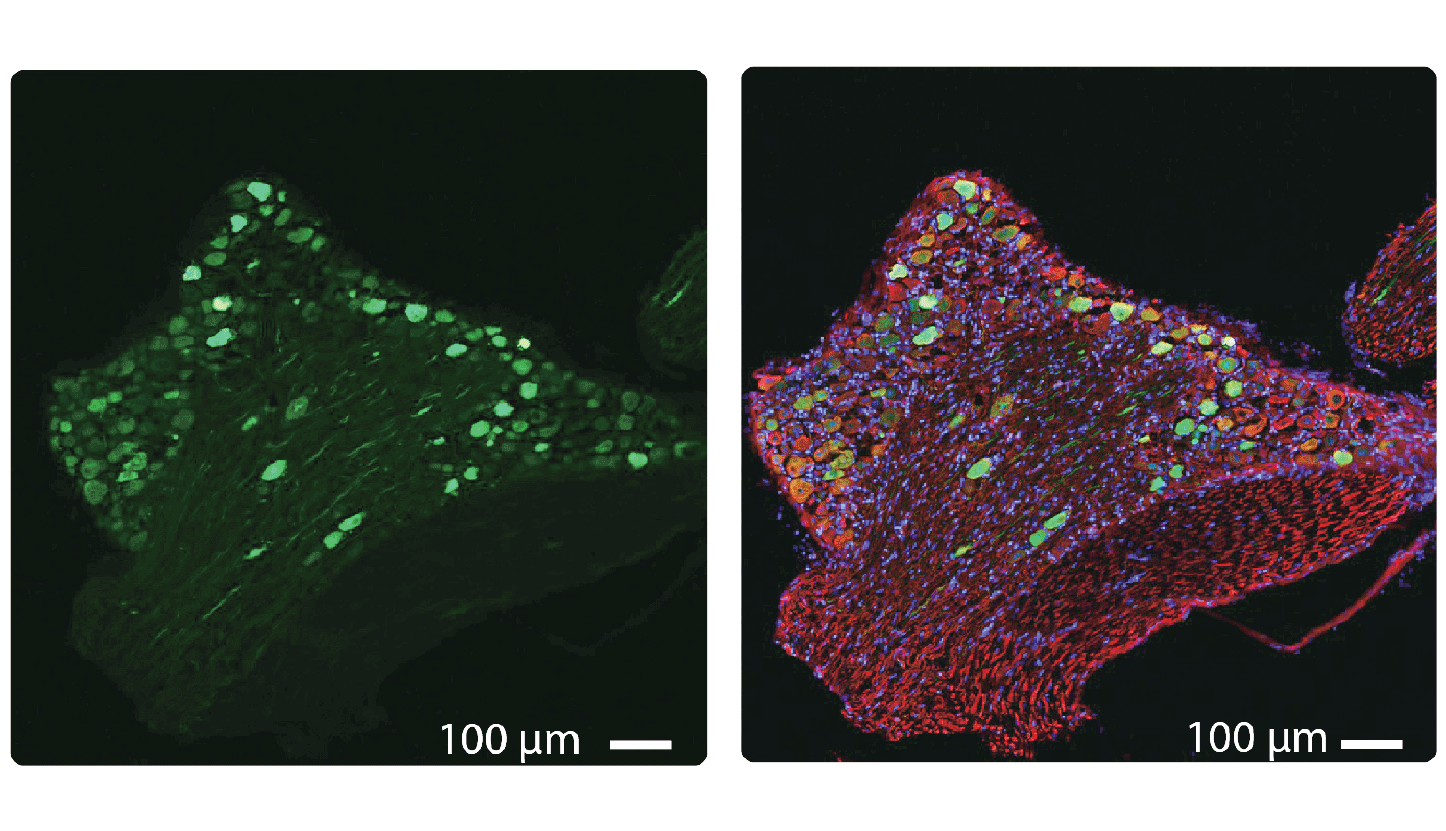
Left: EGFP expression (Green) in lumbar neuronal cells 4 weeks after intrathecal injection of AAV-EGFP Serotype 9 (Cat. # iAAV01509) into mice. Right: Overlay with β-tubulin (red) and DAPI (blue). Image courtesy of Dr. Douglas Lopes, King’s College London.
Yes, the replication and capsid genes are provided in trans when the AAV is produced, therefore the packaged virion only has the ITR sequences and the gene of interest. Furthermore, the cis plasmid and rep/cap plasmid do not share any regions of homology, preventing the production of wild-type AAV through recombination system.
It is recommended to store AAV at -80˚C for long-term storage. For short-term, AAV is stable at 4˚C for up to three weeks without significant loss of activity.
Zhang, Y. et al. "Hypothalamic stem cells control ageing speed partly through exosomal miRNAs." Nature. 548(7665):52-57 (2017). DOI: 10.1038/nature23282. PubMed: 28746310. Application: In vivo infection.
Papes, F. et al. "Transcription Factor 4 loss-of-function is associated with deficits in progenitor proliferation and cortical neuron content." Nature Communications. 13:2387. (2022). DOI: 10.1038/s41467-022-29942-w. PubMed: 35501322.
Li, J. et al. "Activation of the chemokine receptor CCR1 and preferential recruitment of Gαi suppress RSV replication: implications for developing novel RSV treatment strategies." Journal of Virology. 96(22):e0130922. (2022). DOI: 10.1128/jvi.01309-22. PubMed: 36317881
Scano, M. et al. "CFTR corrector C17 is effective in muscular dystrophy, in vivo proof of concept in LGMDR3." Human Molecular Genetics. 31(4):499-509. (2022). DOI: 10.1093/hmg/ddab260. PubMed: 34505136
ABM Assistant
👋 Wrong or incomplete answers mean that the data/columns/tables is missing or needs better descritions. Please write a description or let me know where specifically to find the information for more training.