

Recombinant Mouse IL13 (E. coli)
Cat. No.
Z200245
Unit
Price
$92.00
| Cat. No. | Z200245 |
| Name | Recombinant Mouse IL13 (E. coli) |
| Description | Mouse IL-13 is produced primarily by activated Th2 cells. Human IL-13 is expressed in activated T helper cells (resembling Th0, Th1, Th2), and T cells expressing CD8. The alpha chain of the IL-13 receptor has weak binding activity for IL-13. High affinity receptors are formed when the receptor alpha chains of IL-13 and IL-4 receptors are coexpressed. The receptors for IL-13 and IL-4 share a component, a common gamma subunit that is found also in the IL-2 receptor. Different IL-13 receptor structures have been shown to exist on various cell types and the IL-13 receptor may share more than one component with IL-4 receptor. IL-13 down-modulates macrophage activity, reducing the production of pro-inflammatory cytokines and chemokines in response to IFN-gamma or bacterial lypopolysaccharides. IL-13 enhances the production of the IL-1 receptor antagonist IL-1ra. IL-13 also decreases the production of nitric oxide by activated macrophages, leading to a decrease in parasiticidal activity. IL-13 induces differentiation of human monocytes, enhances survival time in culture, and also induces differentiation and proliferation and isotype switching in B cells. |
| Organism | Mouse (M. musculus) |
| Unit quantity | 10 µg |
| Family | Other Interleukins |
| Tag | Tag Free |
| Aliases | Il-13 |
| Gene Symbol | IL13 |
| Gene ID | 16163 |
| Accession Number | P20109 |
| Source | E. coli |
| Species | Mouse (M. musculus) |
| Appearance | Lyophilized Powder |
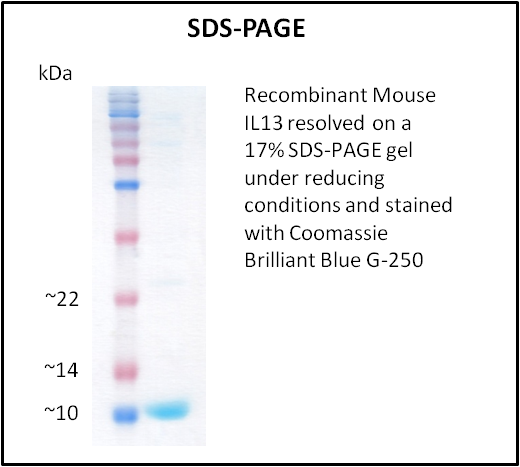
| Molecular Weight | 12 kDa |
| Endotoxin Level | <1.0 EU/µg of recombinant protein as determined by the LAL method. |
| Purity | >95% as determined by SDS-PAGE |
| Formulation | Recombinant mouse IL-13 was lyophilized from a 0.2 μm filtered PBS solution. |
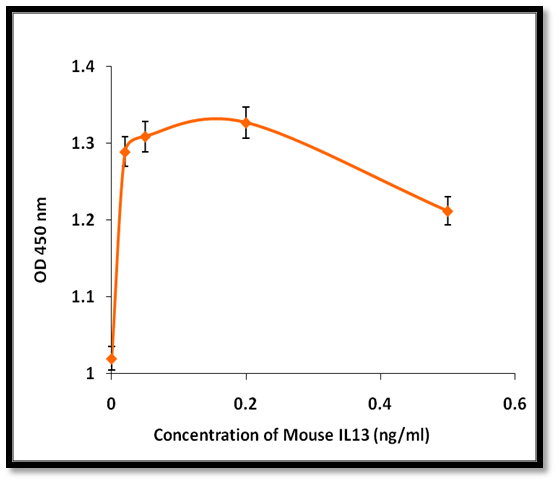
| Function | The ED(50) was determined by the dose-dependent proliferation of TF-1 cells was ≤ 2.0 ng/mL, corresponding to a specific activity of ≥ 1.0 x 10^6 units/mg. |
| Reconstitution | A quick spin of the vial followed by reconstitution in distilled water to a concentration not less than 0.1 mg/mL. This solution can then be diluted into other buffers. |
| Storage | The lyophilized protein is stable for at least one year from date of receipt at -70°C. Upon reconstitution, this cytokine can be stored in working aliquots at 2° - 8°C for one month, or at -20°C for six months, with a carrier protein without detectable loss of activity. Avoid repeated freeze/thaw cycles. |
| Usage | For research use only. Not for diagnostic or therapeutic use. |
| Material Citation | If use of this material results in a scientific publication, please cite the material in the following manner: Applied Biological Materials Inc, Cat. No. Z200245 |
Print/Download Datasheet
| How do I choose the right growth factor for my experiment? | |
|
| What is the shelf life and storage condition of this product? | |
|
The lyophilized protein is stable for at least one year from date of receipt at -70°C. Upon reconstitution, this cytokine can be stored in working aliquots at 2° - 8°C for one month, or at -20°C for six months, with a carrier protein without detectable loss of activity. Avoid repeated freeze/thaw cycles.
|
There are no references for this product yet!
This product has no review yet.
Controls and Related Product: